why do jeans have 7 beltloops
- Share
- Issue Time
- Jul 1,2026
Summary
Discover why 7 belt loops improve waist support. Our integrated B2B factory offers custom waistband construction and strict QC for wholesale brands.
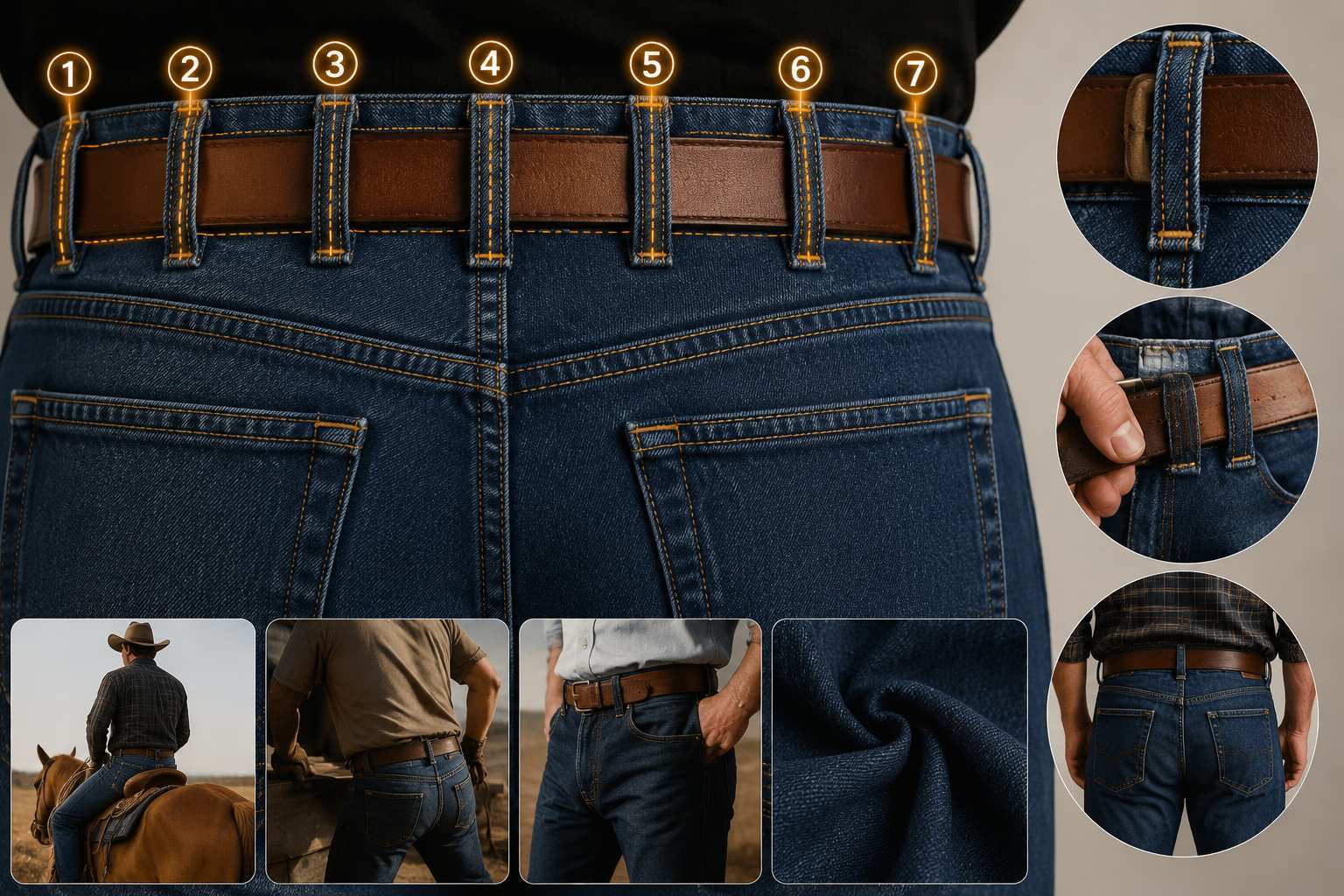
A belt loop is one of those tiny details most shoppers never think about—until it fails, gaps, twists, or makes the waistband feel wrong. On a pair of jeans, belt loops are not just decoration. They help hold the belt in position, distribute tension around the waist, support the waistband during movement, and influence how secure the jeans feel when someone sits, walks, bends, rides, works, or styles the jeans with a heavy belt buckle. That is why some jeans have the standard 5 belt loops, while others—especially western jeans, workwear jeans, plus size jeans, heavy denim jeans, and baggy streetwear jeans—may use 7 belt loops for extra stability.
Jeans have 7 belt loops to spread belt pressure more evenly around the waistband, reduce belt shifting, improve comfort, and add support for heavier denim, wider belts, western styling, workwear use, larger waist sizes, and relaxed fits. While many jeans use 5 belt loops, 7 loops can make the waistband feel more secure and durable.
For denim brands, this small construction choice can become a surprisingly strong selling point. A customer may not search for “bartack reinforcement” before buying jeans, but they will notice if the waistband gaps, the belt pulls unevenly, or a belt loop tears after a few wears. For boutique owners, designers, and private label denim brands, understanding belt loop design is not just technical knowledge—it is product strategy. The difference between 5 and 7 belt loops can affect fit, comfort, durability, customer reviews, product photos, and the perceived value of the jeans.
Why Do Jeans Have Belt Loops in the First Place?
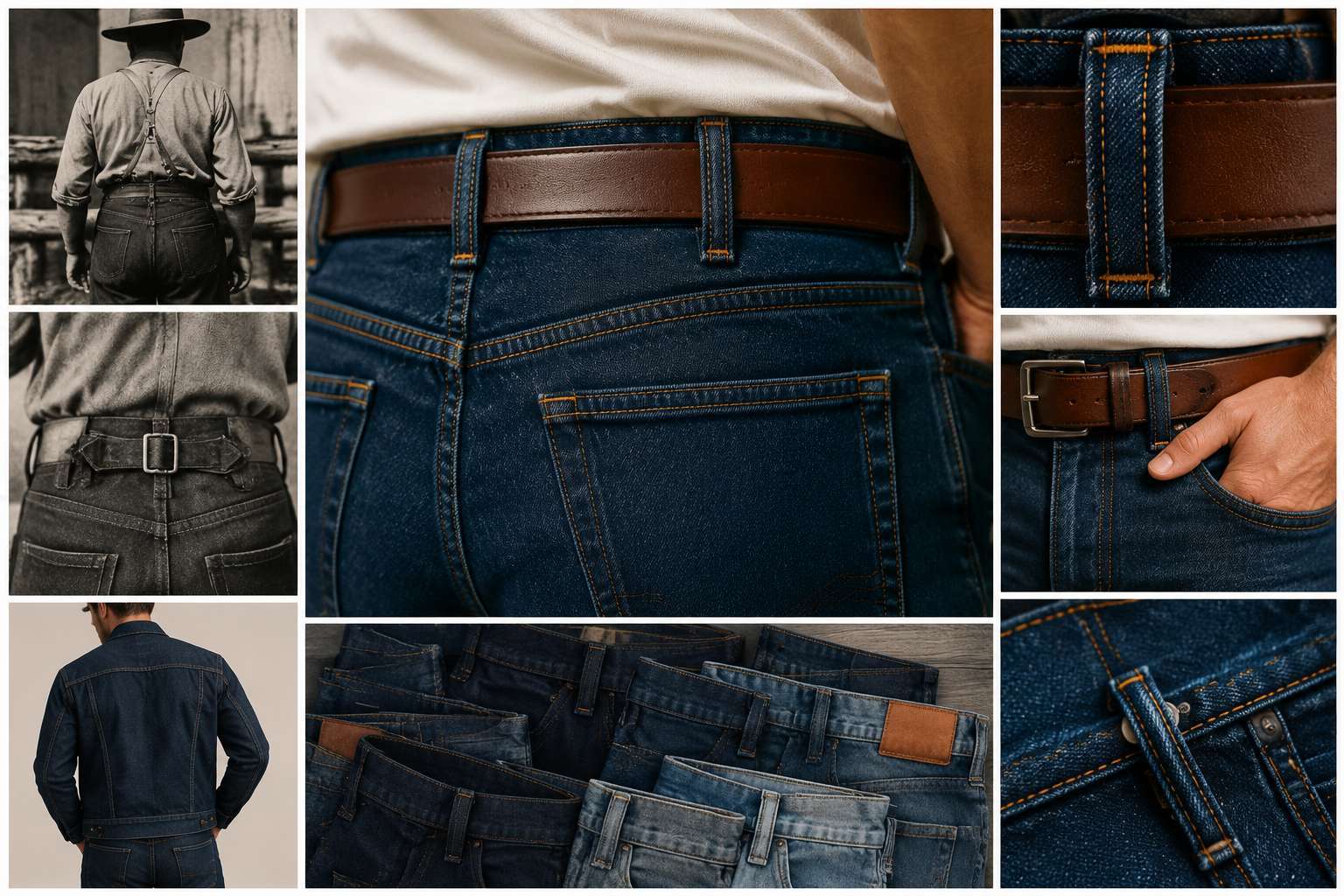
Jeans have belt loops because they help keep a belt fixed around the waistband. Belt loops improve adjustability, support, and styling, especially when denim stretches, relaxes, or shifts during wear. Historically, jeans used suspenders and back cinches before belts became common. Today, belt loops are a basic but important part of modern jeans construction.
What are belt loops on jeans used for?
Belt loops are fabric loops sewn onto the waistband of jeans. Their main job is simple: they hold a belt in place. Without loops, the belt would slide up, down, or away from the waistband. With properly placed loops, the belt can help secure the jeans around the body.
That sounds basic, but it matters a lot in real wear. Jeans move with the body. The waistband may shift when someone sits down, squats, walks, bends, rides a motorcycle, works outdoors, or styles jeans with a tucked shirt. Belt loops help keep the belt and waistband working together instead of separately.
Belt loops also affect styling. A strong belt can change the entire look of a pair of jeans. In western wear, a big buckle is part of the identity. In streetwear, a belt may add attitude. In minimalist fashion, a slim leather belt can make jeans look cleaner and more polished. None of this works well if the loops are weak, badly placed, or too narrow for the belt.
When were belt loops added to jeans?
Early jeans did not always have belt loops. Older work pants often used suspenders, brace buttons, or a back cinch for adjustment. As belts became more common in everyday clothing, jeans gradually changed too. Belt loops became part of modern denim construction because they matched how people actually wanted to wear pants.
This historical shift matters because it shows how denim evolves with lifestyle. Jeans were never frozen in one perfect form. They changed because people changed. Workers moved differently, fashion changed, waistlines changed, belts became more popular, and manufacturers adapted.
For brands today, the lesson is clear: jeans should not be designed only by tradition. They should be designed around the customer’s real wearing habits.
Why did jeans need belt loops instead of only a fitted waistband?
A fitted waistband is helpful, but it is not always enough. Denim can relax during wear. Stretch denim can expand slightly after movement. Raw denim can shrink after washing. A person’s body also changes during the day. Sitting, eating, walking, and bending can all affect how the waistband feels.
Belt loops allow the wearer to fine-tune the fit. If the jeans are slightly loose at the waist but good at the hips, a belt can solve the problem. If the jeans are heavy, a belt helps hold them up. If the customer wears a tucked shirt, belt loops help keep the waist area neat.
Different jeans need different levels of support. Skinny jeans often rely on stretch and close body fit. Baggy jeans rely more on waistband security because the legs carry more fabric volume. Plus size jeans may need more thoughtful waistband support because body curves and waist-to-hip ratios vary more widely. Workwear jeans need loops that can handle movement and heavier belts.
What is the 2 finger rule for jeans?
https://pubs.nmsu.edu/_c/C309/index.htmlhttps://pubs.nmsu.edu/_c/C309/index.html the wearer should be able to slide two fingers comfortably between the waistband and the body. If two fingers cannot fit, the waist may be too tight. If much more space fits easily, the waist may be too loose.
This rule is not perfect, but it is useful because it turns fit into something easy to understand. Customers do not always know technical measurements, but they understand comfort. A waistband should feel secure without digging into the stomach or sliding down.
The 2 finger rule also connects directly to belt loop design. A well-made waistband should fit comfortably even before a belt is added. The belt should support the fit, not rescue a bad pattern. If a jean needs a belt just to stay on the body, the fit may not be right. If the belt pulls the waistband unevenly because the loops are too few or poorly placed, the customer still feels uncomfortable.
Dive Deeper
Belt loops are a small feature, but they reveal a bigger truth about jeans: denim is a product of real life. A beautiful wash, cool pocket shape, or trendy silhouette can attract customers, but comfort and function keep them coming back. Belt loops sit exactly at that connection point between appearance and experience.
For shoppers, belt loops are rarely the first thing they mention. They may say, “These jeans fit well,” “The waist feels secure,” or “The belt sits nicely.” Behind those simple feelings is technical design: loop placement, loop strength, waistband structure, rise, fabric type, and body proportion. A customer may not know the reason, but they feel the result.
This is especially important for online boutiques. Customers cannot try the jeans before buying, so product quality must reduce uncertainty. A stable waistband gives confidence. A clean belt area looks better in product photos. Strong loops make the jeans feel less cheap. These details affect returns, reviews, and repeat purchases.
The 2 finger rule is also useful for e-commerce education. A boutique can use it in size guides, product descriptions, and styling content. For example, a product page might say: “For the best fit, the waistband should allow about two fingers of space. If you plan to wear a thicker belt, choose your regular size.” This type of practical guidance builds trust with customers.
For denim brands, belt loops should be part of the development brief, not an afterthought. A baggy streetwear jean may need wider loops and strong bartacks. A western jean may need 7 loops to support a heavier belt. A plus size high-rise jean may need additional back-waist support to reduce gapping. A premium skinny jean may need cleaner, slimmer loops that do not add bulk.
In short, belt loops are not just there because “jeans always have them.” They are there because jeans must stay on the body, move with the customer, and support the styling story of the brand.
Why Do Some Jeans Have 7 Belt Loops Instead of 5?
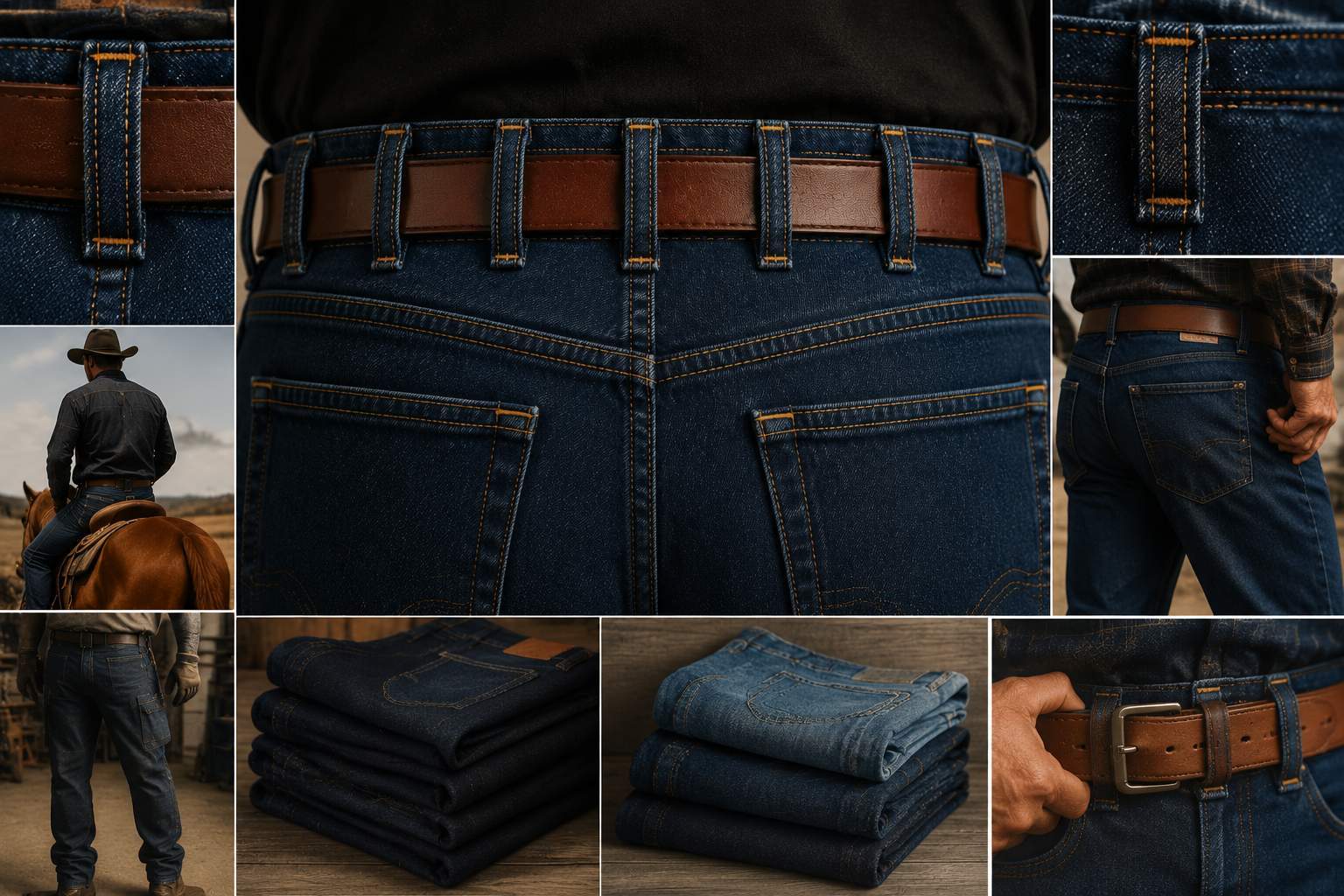
Some jeans have 7 belt loops instead of 5 because extra loops help distribute belt tension more evenly around the waistband. This can reduce belt shifting, waist gapping, back-waist pulling, and loop stress. Seven belt loops are especially useful for western jeans, workwear jeans, heavy denim, plus size jeans, baggy jeans, and jeans worn with wider belts.
How many belt loops do jeans usually have?
Many jeans commonly use 5 belt loops. A typical five-loop layout includes two front loops, two side or back-side loops, and one center-back loop. This layout is enough for many basic fashion jeans, especially if the denim is lighter, the fit is slim, or the customer wears a narrow belt.
But there is no universal law that all jeans must have 5 belt loops. Some jeans use 6, 7, or more depending on the fit, brand identity, waistband size, and target use. A small women’s fashion jean may not need the same support as a men’s heavy workwear jean. A lightweight skinny jean may not need the same loop system as a rigid cowboy jean.
Why do some jeans have 7 belt loops?
Seven belt loops help spread tension around the waistband. Instead of the belt pulling mainly at five points, the force is distributed across more contact points. This can make the belt feel more stable and reduce stress on each loop.
Extra loops can also help prevent the belt from lifting away from the waistband. This matters when the wearer uses a heavier leather belt, a large buckle, or a wider belt. It also matters when the jeans are heavy or roomy. Baggy jeans and workwear jeans carry more fabric, so the waistband needs stronger support.
Seven loops are especially helpful around the back waist. Back-waist gapping is a common issue in jeans, particularly for curvier bodies, high-rise jeans, plus size jeans, and relaxed fits. More loops can help the belt pull the waistband closer to the body in a smoother way.
Do Wrangler jeans have 7 belt loops?
Yes, some Wrangler jeans do have 7 belt loops, especially in the Cowboy Cut category. Wrangler’s Cowboy Cut Original Fit Jean is known for western functionality, higher rise, boot-friendly leg opening, and a 7-loop waistband design. That is not random. It matches the lifestyle of the product.
Western jeans are often worn with tucked shirts, leather belts, belt buckles, and cowboy boots. The waistband needs to stay secure during riding, walking, bending, and working. Extra loops help the belt stay in place and help the shirt remain tucked.
For denim designers, Wrangler is a useful case study. It shows that belt loop count can be part of a product’s identity. Seven loops are not only about math. They support a western look, a functional promise, and a specific customer lifestyle.
Are 7 belt loops better than 5 belt loops?
Seven belt loops are not automatically better for every pair of jeans. They are better when the product actually needs them. If the jean is lightweight, slim, minimal, or designed for a narrow belt, 5 loops may be perfectly enough. Adding 7 loops might make the waistband look too busy or too heavy.
But for heavier jeans, larger sizes, workwear fits, western jeans, and baggy silhouettes, 7 loops can be a smarter choice. The extra loops can improve comfort, stability, and durability. The waistband may feel more controlled, especially when the customer wears a belt for long hours.
The best answer is not “5 is better” or “7 is better.” The best answer is: the belt loop count should match the fit, fabric, rise, waistband width, belt style, and customer use case.
Why do western jeans often use more belt loops?
Western jeans often use more belt loops because they are designed for active movement and heavier styling. Cowboy jeans are commonly worn with thicker belts, large buckles, tucked shirts, and boots. The waistband has to stay stable through movement, not just look good on a hanger.
Extra belt loops support that purpose. They help stop the belt from shifting. They help the shirt stay tucked. They reduce pressure on individual loops. They also create a more rugged visual identity.
That is why 7 belt loops often feel “western,” “workwear,” or “heritage” even before the customer knows the technical reason.
Dive Deeper
The difference between 5 and 7 belt loops is a perfect example of how denim design should be customer-driven. A designer cannot answer the question only by looking at a trend board. The right answer comes from understanding how the customer will wear the jeans.
A fashion-focused customer may want clean, minimal jeans with a smooth waistband and subtle belt loops. A cowboy customer may want a higher rise, secure belt, and loops that handle a large buckle. A streetwear customer may want baggy jeans that sit low or relaxed without slipping. A plus size customer may want a waistband that reduces gapping and feels supportive without pinching.
This is why copying another brand’s construction blindly can be risky. A 7-loop waistband makes sense on a Wrangler Cowboy Cut jean because the whole product is built around western use. But if a brand adds 7 loops to a soft lightweight skinny jean without thinking, the result may feel unnecessary or visually crowded.
However, for many modern denim categories, 7 loops are worth considering. Baggy jeans are still strong in streetwear. Plus size denim demand continues to require better fit engineering. Workwear and western-inspired fashion have strong cultural value. Heavy denim and selvedge jeans attract customers who care about construction details. In all of these categories, extra belt loops can support both function and storytelling.
For boutique owners, 7 belt loops can become a selling detail if explained well. Instead of saying only “custom jeans,” a product description can say: “Designed with 7 reinforced belt loops for better waistband support and a secure fit with wider belts.” That is specific, useful, and customer-centered.
For DiZNEW clients, this opens up strong product development possibilities. A U.S. boutique could create 7-loop baggy jeans for streetwear buyers, 7-loop plus size jeans for better waist support, or 7-loop western jeans with a boot-friendly leg opening. With custom manufacturing, belt loop number, width, stitching, placement, and reinforcement can all be adjusted to match the brand’s target customer.
How Do 7 Belt Loops Improve Fit, Comfort, and Durability?
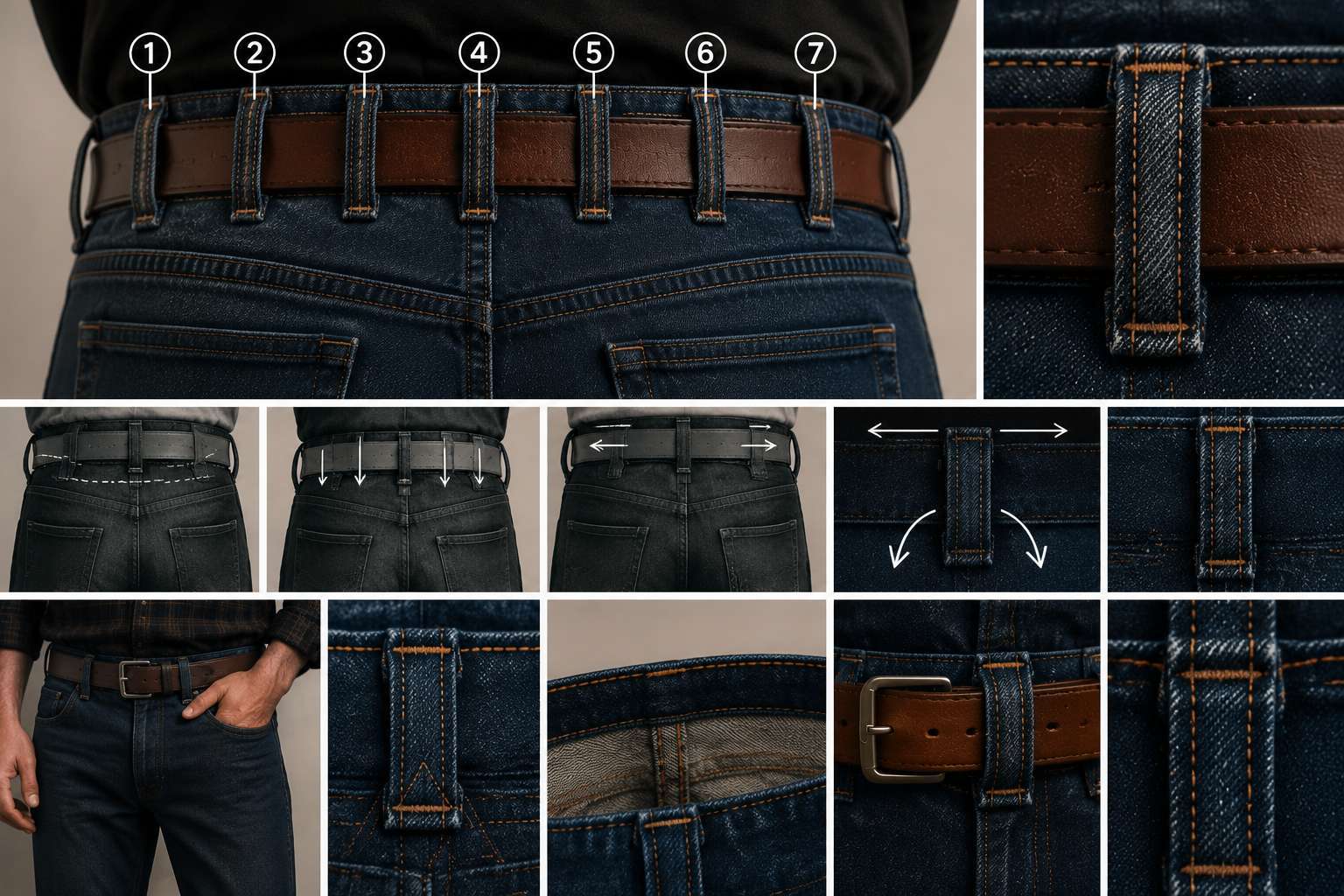
Seven belt loops can improve jeans by making the belt sit more evenly around the waist. Extra loops can reduce waistband gapping, spread pressure, keep the belt from shifting, and lower stress on each loop. When combined with strong bartacks, good waistband fabric, and proper placement, 7 loops can make jeans feel more secure and durable.
Do extra belt loops help prevent waistband gapping?
Extra belt loops can help reduce waistband gapping, especially when they are placed strategically around the back waist. Gapping happens when the waistband does not sit close to the body. This is common for people with a smaller waist and fuller hips, and it is also common in relaxed or high-rise jeans.
A belt can pull the waistband closer, but only if the loops guide the belt properly. If there are too few loops, the belt may pull in certain areas while leaving gaps in others. More loops can help the belt follow the waistband more evenly.
This does not mean belt loops can fix a bad pattern. If the jeans are poorly graded or the back rise is wrong, extra loops will not solve everything. But good loop placement can support a better fit.
Can 7 belt loops make jeans more comfortable?
Yes, 7 belt loops can make jeans more comfortable when the jeans need more waist support. More loops can spread belt pressure across more points. This may reduce the feeling of one loop pulling too hard or the belt digging unevenly into the waist.
This is especially useful for people who wear jeans for long hours. Workers, travelers, drivers, performers, stylists, and streetwear customers may wear jeans all day. A more stable waistband can make a noticeable difference.
Comfort is not only about stretch. It is also about pressure distribution, waistband shape, rise, fabric recovery, and how the jeans behave during movement.
Do more belt loops make jeans more durable?
More belt loops can help durability by reducing stress on each individual loop. If a belt is pulling through 7 loops instead of 5, each loop may carry less tension. But durability depends on construction quality too.
A weak 7-loop jean can still fail. A strong 5-loop jean can still perform well. The key is reinforcement. Belt loops should be attached with strong bartacks or secure stitching at stress points. The waistband should be made from suitable fabric. The loop itself should have enough structure to handle pulling.
Why do belt loops sometimes rip off jeans?
Belt loops often rip because of weak stitching, thin fabric, poor reinforcement, repeated stress, heavy belts, or customers pulling jeans up by the loops. Many people use belt loops like handles, especially when putting on tight jeans. That puts a lot of strain on a small piece of fabric.
Once a loop starts to tear, the damage can spread into the waistband. This is not just a repair issue. It affects customer trust. A ripped belt loop makes jeans feel cheap, even if the wash and fit looked good at first.
For private label brands, this is a quality control point that should be checked before bulk approval. Pull testing, bartack inspection, stitch density, and loop alignment all matter.
What does belt loop quality reveal about denim craftsmanship?
Belt loop quality reveals how carefully the jeans were made. Clean alignment, strong bartacks, consistent width, neat folding, balanced placement, and good thread tension all signal better manufacturing.
Customers may not inspect loops like a technician, but they notice the overall feeling. Premium jeans feel secure. Cheap jeans often feel loose, flimsy, or uneven. Belt loops contribute to that impression.
Dive Deeper
Fit, comfort, and durability are connected. A jean that fits poorly usually feels uncomfortable. A jean that feels unstable often gets pulled and adjusted more often. A jean that gets pulled more often puts more stress on belt loops and seams. Over time, weak construction becomes a customer complaint.
This is why belt loops are not a “small problem.” They are part of the larger waistband system. The waistband includes pattern shape, rise, yoke, back curve, fabric behavior, interlining, button placement, fly construction, loop placement, and belt compatibility. If one part is wrong, the whole waist can feel wrong.
For plus size jeans, this becomes even more important. Plus size customers often deal with waist gapping, rolling waistbands, uncomfortable pressure, and inconsistent grading. A thoughtful 7-loop waistband can help create better belt stability, but it must be paired with proper plus size pattern development. Simply scaling up a smaller size is not enough.
For baggy and stacked jeans, the issue is different. The jeans may have more fabric weight and a looser silhouette. The waistband must control that volume without making the wearer feel restricted. Extra loops can help stabilize the belt and prevent the jeans from sagging in an unintentional way.
For western and workwear jeans, durability is central. The customer expects the product to handle movement and repeated use. In these categories, belt loop failure is especially damaging because the jean’s identity is based on toughness.
For brands, the business impact is real. Better belt loop construction can reduce returns, improve reviews, and support a higher retail price. It also gives the brand more details to show in product photography. A close-up of reinforced belt loops, branded bartacks, or a special back-loop design can make a product page feel more premium.
DiZNEW can support this kind of development by adjusting belt loop quantity, placement, width, stitching, bartack color, reinforcement method, and waistband structure based on the target product. That is the difference between generic wholesale jeans and custom denim made with the buyer’s customer in mind.
Which Jeans Styles Benefit Most From 7 Belt Loops?
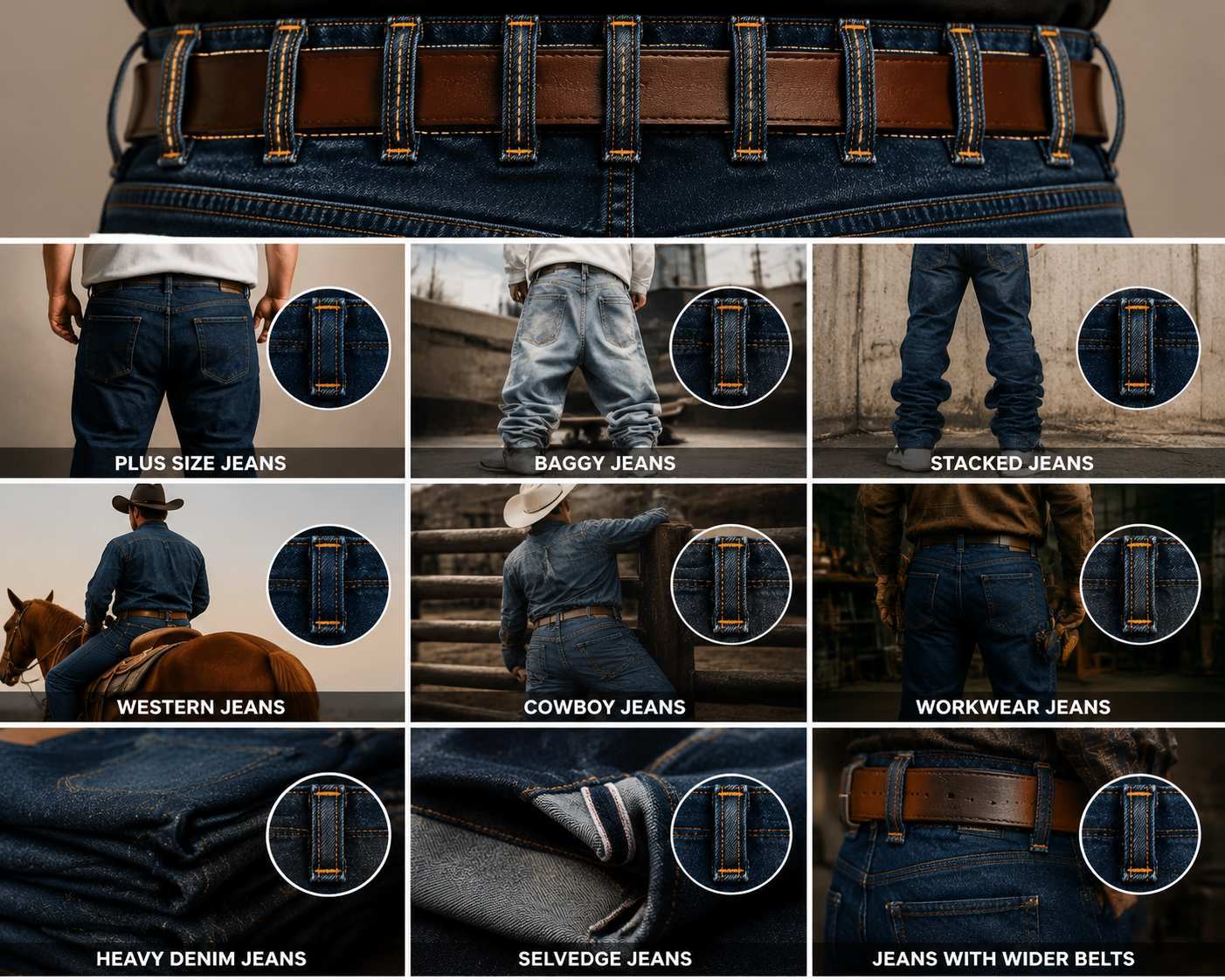
The jeans that benefit most from 7 belt loops are plus size jeans, baggy jeans, stacked jeans, western jeans, cowboy jeans, workwear jeans, heavy denim jeans, selvedge jeans, and jeans worn with wider belts. Skinny jeans may not always need 7 loops, but premium or plus size skinny jeans can still benefit from stronger waistband support.
Do plus size jeans need more belt loops?
Plus size jeans can benefit from more belt loops because the waistband often needs better support and smoother tension distribution. Many plus size customers need jeans that fit the waist and hips without gapping, squeezing, or sliding.
Seven belt loops can help the belt sit more evenly around the body. This is especially helpful for high-rise jeans, curvy fits, and jeans with heavier fabric. But again, the loops must work together with the pattern. Strong loops cannot replace good plus size grading.
For brands, plus size jeans should not be treated as an afterthought. Customers in this category often care deeply about comfort, security, and confidence. A better waistband can be a major selling point.
Do baggy jeans and stacked jeans need 7 belt loops?
Baggy jeans and stacked jeans often benefit from 7 belt loops because they usually have more fabric volume. A baggy jean may feel loose and heavy if the waistband is not stable. A stacked jean may have extra inseam length that adds visual and physical weight. Extra loops help keep the waist controlled.
Streetwear customers often wear wider belts, oversized tops, cropped jackets, or visible waist styling. That makes belt loops more important visually too. Wider loops or reinforced loops can make the jeans feel more intentional and more premium.
For U.S. boutique buyers, this is especially relevant. Baggy, stacked, relaxed, and streetwear-inspired jeans remain strong categories. A 7-loop waistband can support the look and improve the wearing experience.
Are skinny jeans out of style in 2026?
Skinny jeans are not completely out of style in 2026, but they are no longer the only default denim silhouette. The market is more diverse now. Wide-leg, baggy, straight, relaxed, flare, barrel, and stacked jeans are all influential, while skinny jeans are returning in more modern, intentional styling.
The old “spray-on skinny with everything” look is less dominant. Modern skinny jeans are often styled with cleaner tops, boots, blazers, refined basics, better stretch fabrics, darker washes, or sleek layered outfits. In other words, skinny jeans are not dead—they are being repositioned.
For denim brands, the best strategy is not to eliminate skinny jeans. It is to offer the right mix of fits for different customers.
Do skinny jeans need 7 belt loops in 2026?
Most skinny jeans do not need 7 belt loops because they rely on close fit and stretch fabric. Five loops are often enough for lightweight or fashion-focused skinny jeans. However, 7 loops can still be useful for certain skinny styles.
Plus size skinny jeans may benefit from more waistband support. Heavy denim skinny jeans may need stronger belt stability. Premium skinny jeans designed for wider belts or western styling may also use more loops. The decision should follow the product, not the trend label.
A skinny jean made for comfort stretch and clean fashion styling may use 5 loops. A skinny jean made for rugged western wear or inclusive sizing may use 7.
Do selvedge jeans and workwear jeans need extra belt loops?
Selvedge jeans and workwear jeans often benefit from stronger waistband construction because they are usually made with heavier denim and attract customers who care about detail. These customers may inspect the fabric, stitching, rivets, loops, patch, pocket bags, and hem construction.
Extra belt loops can support function and premium positioning. On a heavy raw denim jean, a weak waistband feels wrong. On a heritage workwear jean, 7 loops can reinforce the idea of durability.
Do jogger jeans, denim shorts, and denim jackets need the same belt loop logic?
Jogger jeans may use elastic waistbands, drawstrings, or hybrid belt loops depending on the design. They do not always need 7 loops, but they still need waistband stability. Denim shorts often need strong belt loops because the waist is highly visible and frequently styled with belts. Denim jackets do not use belt loops, but the same construction logic applies to tabs, seams, buttons, labels, and reinforcement points.
The bigger lesson is that every denim product has stress points. A good factory understands where the garment needs strength and where it needs style.
Dive Deeper
The 2026 denim market is not controlled by one silhouette. That is good news for brands, but it also makes product planning more complex. Customers are split across different style identities. Some want relaxed streetwear. Some want western heritage. Some want clean minimal denim. Some want curve-friendly plus sizes. Some want premium selvedge. Some still want skinny jeans, but styled in a more updated way.
This means belt loop design should be customized by product category.
A plus size high-rise jean should focus on comfort, waist stability, and reduced gapping. A baggy hip-hop jean should focus on waistband control, fabric volume, and streetwear styling. A stacked jean should consider inseam length and how the waist holds the extra leg volume. A selvedge jean should show craftsmanship. A western jean should support wider belts and buckles. A skinny jean should avoid unnecessary bulk unless the target customer needs extra support.
This is also where the question “Are skinny jeans out of style in 2026?” becomes useful for sourcing. The answer is not simply yes or no. The better answer is that denim has entered a multi-fit market. Brands that only sell one fit may miss customers. Brands that understand fit segmentation can build stronger collections.
For a boutique, the ideal denim line might include:
A baggy jean for streetwear buyers.
A straight jean for everyday customers.
A stacked jean for trend-focused shoppers.
A plus size jean with better waistband engineering.
A selvedge jean for premium denim fans.
A skinny jean for customers who still want a fitted silhouette.
Each of these jeans may need a different belt loop strategy. That is why working with a custom denim manufacturer can be more valuable than buying generic wholesale stock. Wholesale jeans are already decided. Custom jeans can be engineered for the store’s specific customer.
DiZNEW can help brands adjust belt loop count, waistband structure, fabric weight, wash, fit, sizing, trim, and packaging across many denim categories. For small brands, this creates a practical path: start with a 30-piece test order, study customer feedback, then scale the styles that perform best.
How Can Denim Brands Customize Belt Loops for Better Product Value?
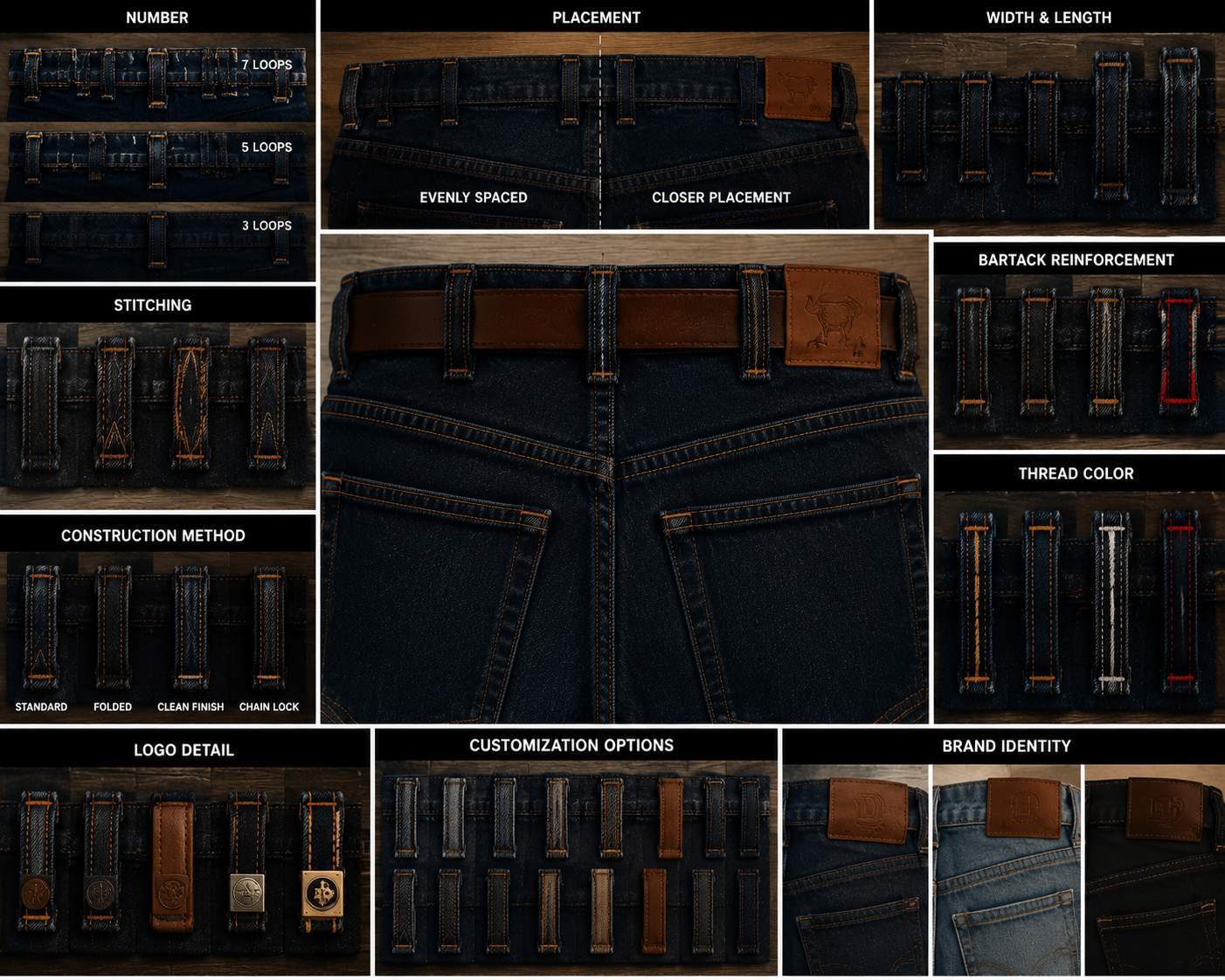
Denim brands can customize belt loops by changing the number, placement, width, length, stitching, bartack reinforcement, thread color, construction method, and logo detail. Belt loop design can improve fit, durability, and brand identity. For boutique owners, strong belt loop construction helps custom jeans feel more premium than generic wholesale jeans.
What belt loop details can be customized on jeans?
Belt loops can be customized in many ways, including:
5, 6, 7, or custom loop placement.
Wider loops for western or workwear jeans.
Slimmer loops for clean fashion jeans.
Double-layer loops for durability.
Tucked belt loops sewn into the waistband.
Standard attached loops with visible bartacks.
Contrast stitching or tonal stitching.
Colored bartacks.
V-shaped, crossed, or special back-loop designs.
Logo embroidery or branded loop details.
These details may seem small, but they can change the look and performance of the jeans.
How does belt loop design affect the look of jeans?
Belt loop design affects the visual balance of the waistband. Wider loops feel more rugged, western, and workwear-inspired. Slimmer loops feel cleaner and more fashion-focused. Contrast stitching makes the waistband more noticeable. Tonal stitching makes it quieter.
The loops are especially visible when the customer wears a tucked shirt, cropped top, short jacket, or statement belt. In product photos, belt loops can frame the top block of the jeans and make the waistband look more complete.
For private label brands, these details can support identity. A streetwear brand may want bold loops. A premium minimalist brand may want clean loops. A western brand may want 7 strong loops. A plus size brand may want functional loops placed for comfort and support.
What jeans cost $100,000?
A pair of Levi’s jeans dating back to 1873 sold for $100,000 at auction. That story became popular because it shows how denim can become collectible when age, rarity, history, brand heritage, condition, construction, and cultural meaning come together.
Most modern brands are not trying to make auction pieces today. But the lesson is still useful: denim details matter over time. Rivets, loops, stitching, patches, fabric, fading, and construction all become part of a jean’s story.
When brands invest in quality, they are not only making a product for today’s sale. They are building perceived value.
Why should boutique owners care about belt loop construction?
Boutique owners should care because customers feel quality even when they cannot explain it. A jean with poor belt loops may twist, pull, rip, or make the waistband feel unstable. That can lead to complaints, returns, bad reviews, and lower trust.
Good belt loop construction gives boutique owners more confidence when selling. It also creates more details to show in product photography and product descriptions. Instead of competing only on price, a boutique can explain the construction value.
A custom jean with reinforced loops, branded hardware, better fabric, and a strong waistband feels different from a generic wholesale jean.
How can DiZNEW help brands develop custom jeans with 7 belt loops?
DiZNEW can help brands develop custom jeans with 7 belt loops by adjusting loop count, placement, width, stitching, bartack reinforcement, waistband structure, fabric, rise, fit, wash, and branding. This is useful for U.S. boutique owners, online denim brands, streetwear designers, high-end custom clients, and private label buyers.
DiZNEW can customize plus size jeans, baggy jeans, stacked jeans, straight jeans, selvedge jeans, skinny jeans, jogger jeans, denim jackets, denim shorts, denim shirts, and other denim products. The factory supports small-batch custom testing from 30 pieces and can also handle larger orders up to 10,000 pieces.
How can brands turn small denim details into stronger selling points?
Brands can turn small denim details into selling points by showing them clearly. Product pages should include close-up photos of belt loops, rivets, buttons, leather patches, stitching, pocket shapes, wash effects, and inside finishing. Social media videos can show the waistband, belt styling, fit test, and movement.
Customers buy more confidently when they understand why a product is better. Instead of only saying “premium denim,” brands should explain what makes it premium.
For example:
“7 reinforced belt loops for better waistband stability.”
“Double bartack construction at stress points.”
“Custom leather patch and branded rivets.”
“Designed for wide belts and western styling.”
“Plus size waistband engineered to reduce back gapping.”
Specific details build trust.
Dive Deeper
In a crowded denim market, small details create separation. Many stores can sell blue jeans. Many suppliers can make a basic five-pocket style. But not every brand can explain why its jeans fit better, last longer, and feel more considered.
This is where belt loops become surprisingly powerful. They are easy to overlook, but they sit in one of the most important areas of the garment: the waistband. The waistband affects fit confidence. Fit confidence affects whether customers keep the jeans. Customer satisfaction affects reviews, returns, and repeat orders.
For boutique brands, the goal is not to add random details. The goal is to add meaningful details. Seven belt loops should not be used just because the number sounds better. They should be used when the customer benefits from them. A western jean, plus size jean, baggy jean, workwear jean, or heavy selvedge jean may gain real value from 7 loops. A slim fashion jean may not.
The $100,000 vintage jeans story also reminds us that denim value is built through history and detail. Rare jeans become valuable because they carry evidence of time, construction, and cultural meaning. Modern brands cannot manufacture age, but they can manufacture intention. They can choose better fabrics, stronger loops, better stitching, thoughtful washes, and custom branding.
For e-commerce, details also support SEO and conversion. Searchers ask specific questions: “Why do jeans have 7 belt loops?” “Do Wrangler jeans have 7 belt loops?” “What is the 2 finger rule for jeans?” “Are skinny jeans out of style in 2026?” A brand that answers these questions builds authority. A product page that explains construction builds confidence. A blog that connects fit, history, trends, and manufacturing gives customers a reason to trust the seller.
DiZNEW is positioned to help brands turn these insights into real products. Whether the buyer has a sketch, a reference photo, a physical sample, or a full tech pack, DiZNEW can help develop custom denim with the right belt loop system, waistband construction, fabric, wash, fit, trims, labels, packaging, and production plan.
Final Thoughts: 7 Belt Loops Are Small, But They Can Make Jeans Feel Better
So, why do jeans have 7 belt loops? Because some jeans need more waistband support than others. Seven loops can help distribute belt tension, reduce shifting, support heavier fabric, stabilize relaxed silhouettes, improve comfort, and strengthen the overall waistband experience. They are especially useful for western jeans, workwear jeans, plus size jeans, baggy jeans, stacked jeans, heavy denim, and jeans worn with wider belts.
But 7 belt loops are not automatically better for every pair of jeans. A good denim brand chooses loop count based on the product’s purpose. Skinny jeans, straight jeans, selvedge jeans, jogger jeans, denim shorts, and baggy jeans all have different construction needs. The best jeans are not made by following one rule. They are made by understanding the customer.
For boutique owners, online stores, denim designers, and private label buyers, belt loops are a reminder that small details matter. Customers may first notice the wash or silhouette, but they remember how the jeans feel. A secure waistband, strong loops, clean stitching, and reliable fit can turn a first-time buyer into a repeat customer.
DiZNEW is a China-based denim R&D, manufacturing, and sales factory with more than 20 years of experience. We specialize in custom denim products for U.S. small and medium buyers, high-end brand clients, denim designers, online boutique owners, and influencer-led fashion stores. We can help turn your sketch, reference photo, sample, or tech pack into real custom denim products under your own logo.
DiZNEW can customize plus size jeans, baggy jeans, stacked jeans, straight jeans, selvedge jeans, skinny jeans, jogger jeans, denim jackets, denim shorts, denim shirts, and more. We support custom fabric, washing, fit, waistband construction, belt loop number and placement, labels, buttons, rivets, leather patches, hang tags, packaging, and OEM/ODM private label production.
If you want to test a new denim idea, DiZNEW offers low MOQ custom production starting from 30 pieces. If you already have a proven product and need larger production, we can also support bulk orders up to 10,000 pieces.
Ready to create custom jeans with better fit, stronger belt loops, and more premium denim details? Contact DiZNEW today to request a quote, develop samples, and start building your next denim best-seller.
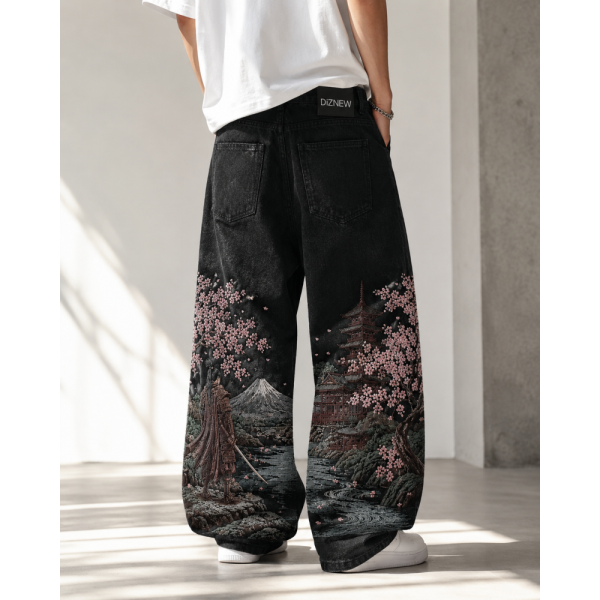
Premium wide-leg denim jeans featuring a vintage washed black finish, detailed Japanese landscape artwork, embroidery-style decoration, and custom brand label options. Designed for streetwear brands, designer labels, and private label collections looking for statement denim with strong visual storytelling.
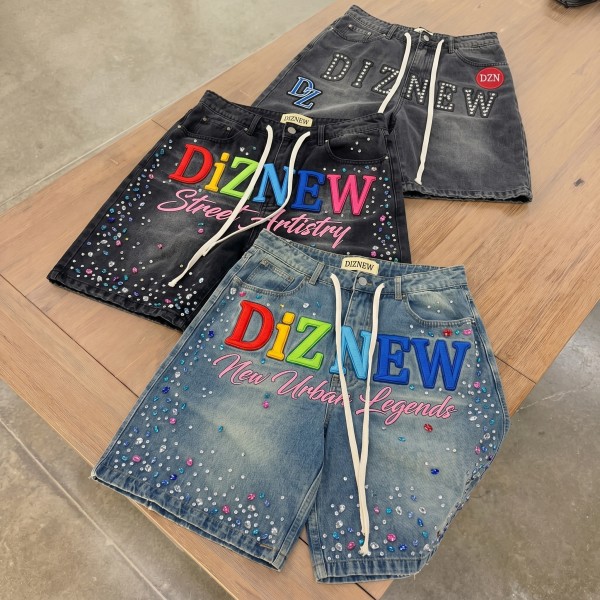
Custom Rhinestone Logo Denim Shorts: Wholesale supply direct. We manufacture premium embroidered baggy jean shorts for brands.
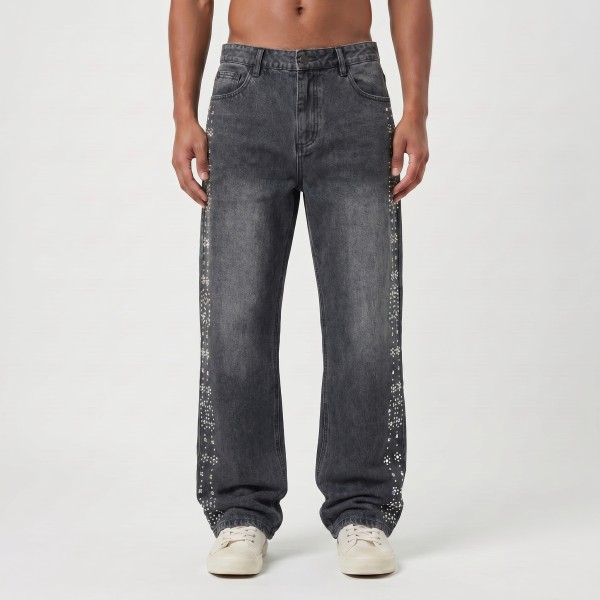
Discover premium DiZNEW denim jeans with decorative studs for a sparkling, stylish look. Order today!
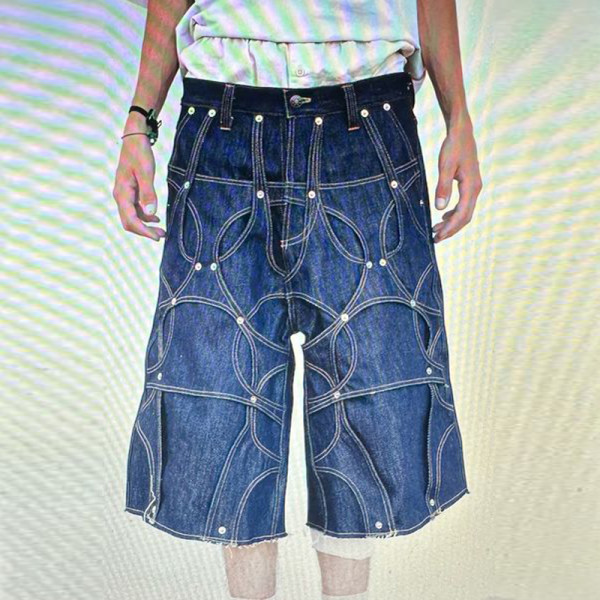
These designer denim shorts for men feature intricate decorative stitching and rivet details, perfect for streetwear fashion. The wide-leg silhouette adds a bold look, ideal for trendsetters.