Are jeans denim or cotton?
- Share
- publisher
- Jimy
- Issue Time
- Oct 30,2026
Summary
Are jeans denim or cotton? Denim is a cotton twill! Our B2B factory helps wholesale brands source premium fabrics for custom jeans manufacturing.
Two pairs of jeans can look almost identical online and feel completely different when you put them on. One holds a crisp, roomy silhouette. The other bends easily at the knee and follows your body. Both product descriptions say “denim,” yet only one label says “100% cotton.” So which description actually tells you what you’re buying?
For shoppers, this confusion can lead to an uncomfortable purchase. For designers and boutique owners, it can lead to a more expensive problem: choosing fabric that looks right in a photo but behaves differently after cutting, washing, or everyday wear. Understanding the terminology helps you ask better questions before committing to a sample or production order.
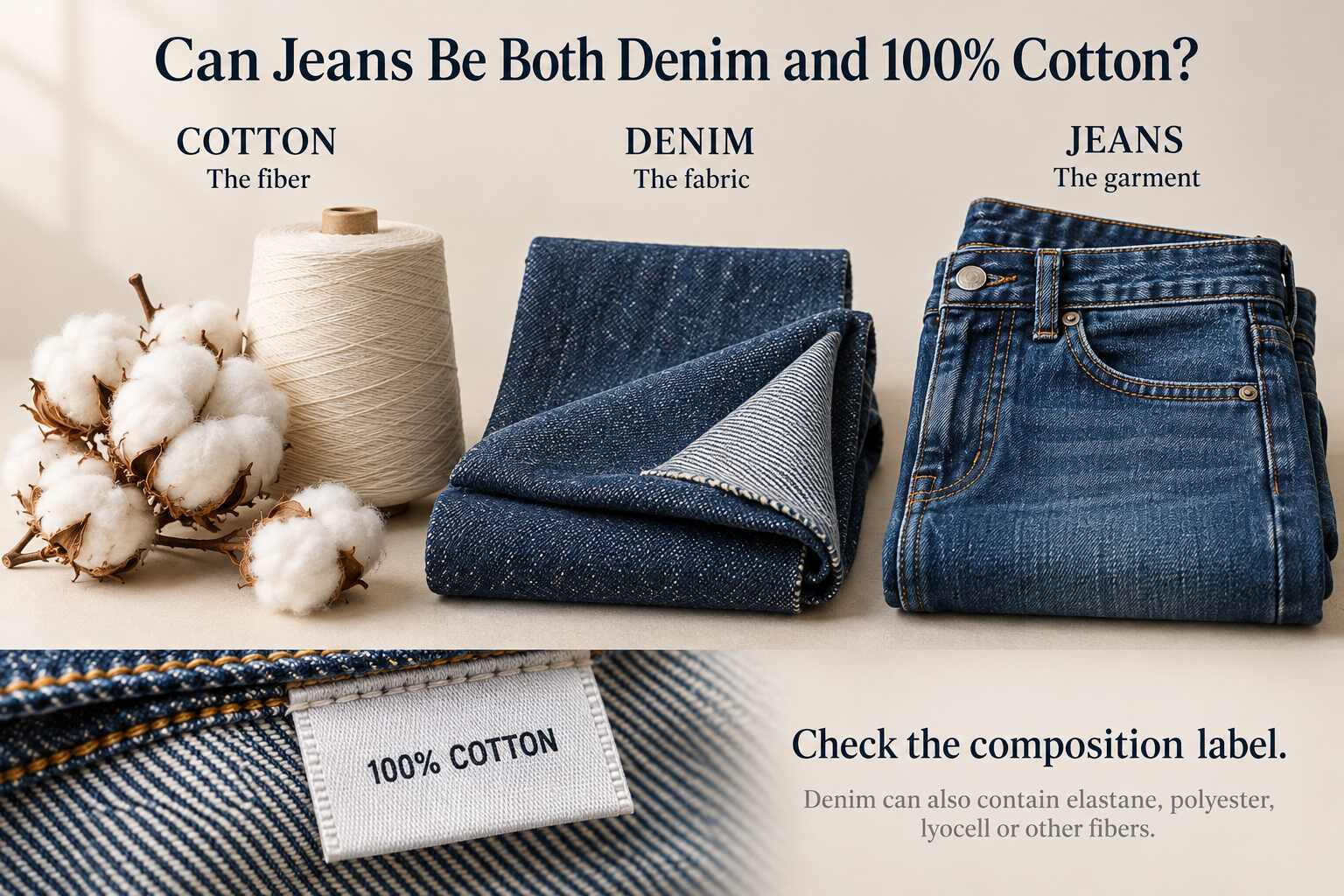
Jeans are usually made from denim, and denim is traditionally made from cotton. Cotton is a fiber, denim is a fabric, and jeans are the finished garment. A pair can therefore be both denim and 100% cotton. However, many modern denim jeans blend cotton with elastane, polyester, lyocell, or other fibers to adjust stretch, softness, drape, and performance. Check the specific product’s composition label to know what it contains.
That distinction matters whether you’re buying a favorite everyday pair or developing a private-label collection. The percentage on the label is useful, but it doesn’t tell the whole story.
Imagine approving a structured straight-leg sample, then receiving a softer production version that collapses around the ankle. The color matches. The cotton percentage matches. The silhouette doesn’t. To understand why, you need to look beyond the word “cotton.”
What Is the Difference Between Cotton, Denim, and Jeans?
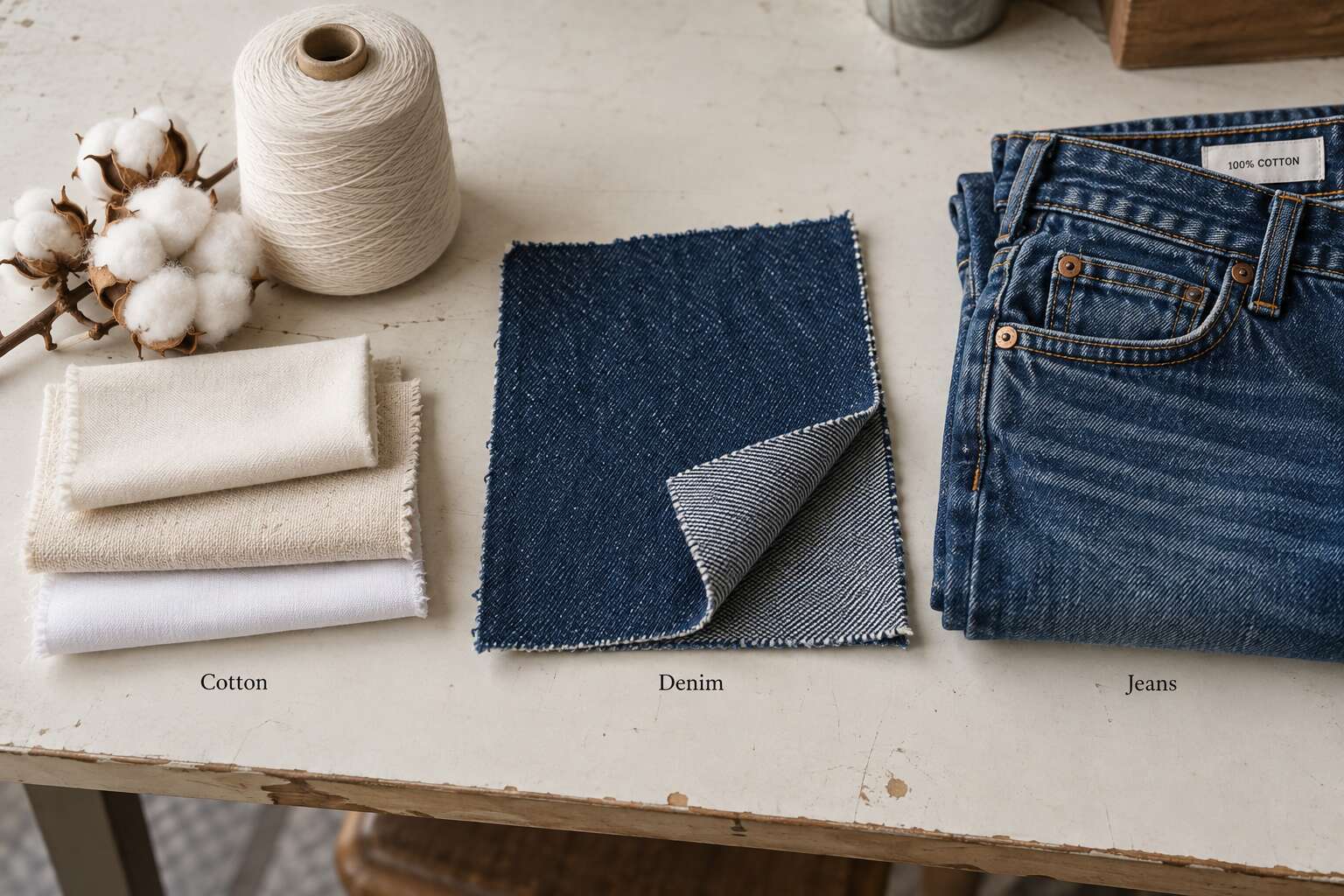
Cotton describes the fiber, denim describes the fabric, and jeans describe the garment. Denim is traditionally a sturdy, warp-faced twill woven from cotton yarns, although cotton blends are also common. Cotton can also become jersey, canvas, poplin, and many other fabrics. This means cotton clothing is not automatically denim, while denim jeans can legitimately carry a 100% cotton composition label.
What is cotton, and how is it used to make denim?
Cotton is a natural fiber that can be spun into yarn and then woven or knitted into fabric. In denim production, yarn selection helps establish the fabric’s character before a pattern is cut. Two all-cotton fabrics can use different yarn thicknesses, twists, and surface textures. One may have a smoother face; another may show deliberately irregular slubs. For a brand owner, “100% cotton” identifies composition, but leaves many development decisions open. Ask for a physical swatch and the fabric specification alongside the fiber percentage.
What makes denim different from other cotton fabrics?
Denim’s recognizable diagonal texture comes from its twill weave. Classic blue denim generally uses indigo-colored warp yarns running lengthwise and lighter weft yarns running across the fabric. This construction helps explain the familiar darker face and lighter reverse. However, denim does not have to be blue: black, ecru, and other colors are possible. Levi’s defines denim as a durable cotton or cotton-blend twill textile. For sourcing, that is a useful starting point, but color and a diagonal surface alone are insufficient to confirm a fabric’s complete specification.
How are jeans different from denim?
Jeans are trousers, commonly recognizable by details such as a fly, belt loops, and pocket construction. Denim is the cloth used to make them and can also become jackets, shorts, shirts, and skirts. This distinction makes supplier conversations more productive. “We need denim” leaves the garment, weight, finish, and performance unresolved. “We need denim for a relaxed five-pocket jean with a structured leg and a washed vintage surface” gives a developer a clearer direction. The next step is to translate that direction into measurable specifications.
Can jeans be both denim and 100% cotton?
Yes. There is no contradiction between a denim product description and a 100% cotton label. They answer different questions, as the table below shows. Be equally careful with the phrase “cotton jeans,” which does not tell you whether the fabric is all cotton or a blend unless a percentage is supplied. On your own product pages, describe both the fabric and its composition. That helps customers understand the item and gives your production team a more precise reference when sourcing fabric for repeat orders.
| Term | What it identifies | What it does not establish |
| Cotton | A fiber | Weave, fabric weight, or finished fit |
| Denim | A fabric category | Exact fiber percentages or stretch performance |
| Jeans | A garment category | Whether its fabric is rigid or stretchy |
100% cotton denim jeans | Garment, fabric, and fiber composition | Wash behavior, durability, or recovery by itself |
Are All Denim Jeans Made from 100% Cotton?
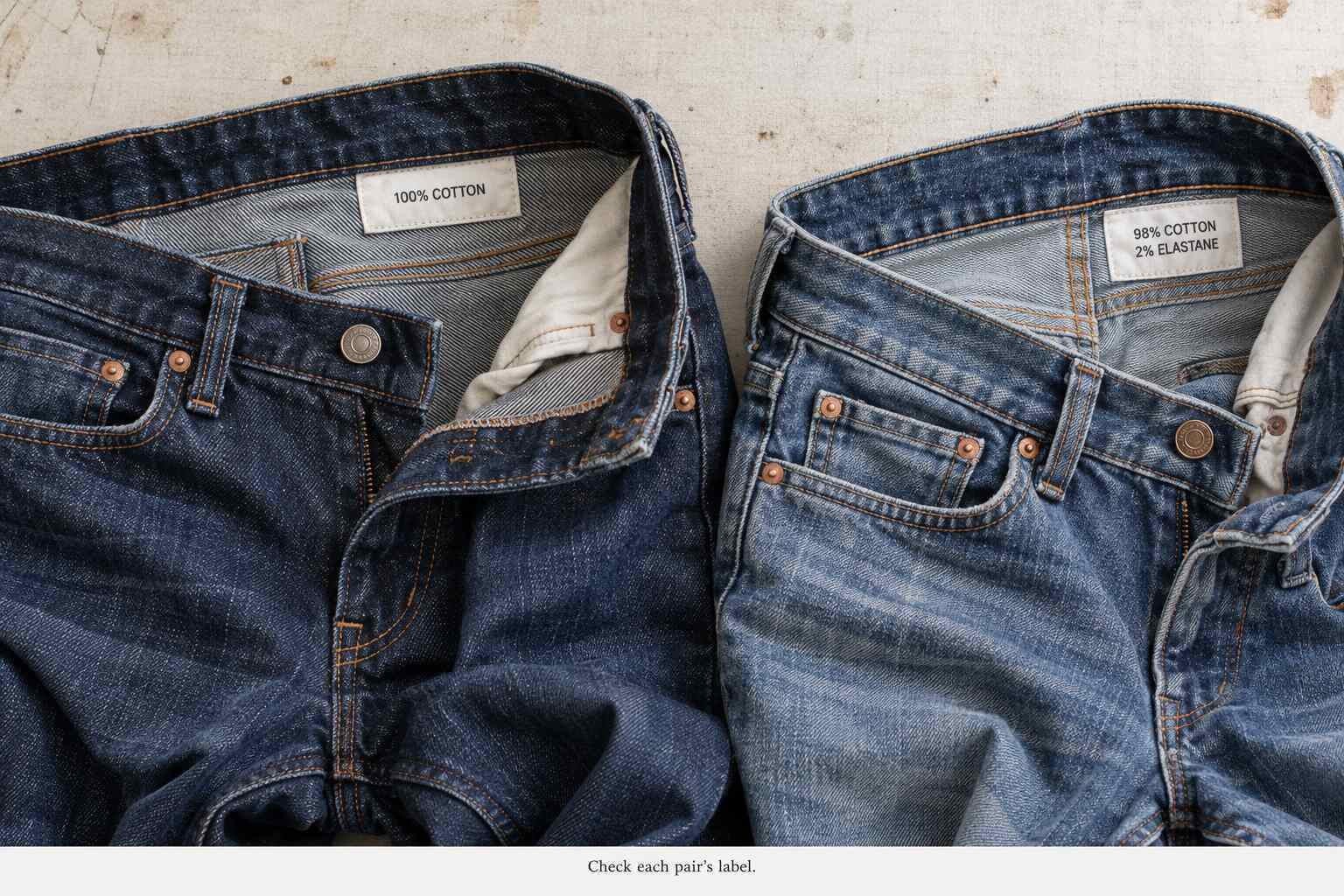
No. Denim jeans may contain 100% cotton or a blend of cotton and other fibers. Both all-cotton and blended options remain available from established brands, including Levi’s and Wrangler. The reliable way to identify a pair’s composition is to check the exact style, color or wash, product code, and label rather than assuming every jean from one brand uses the same fabric.
Are jeans typically 100% cotton?
All-cotton denim is a traditional choice, particularly for jeans designed around a firm, vintage, or workwear-inspired feel. Modern collections also offer many blends, so there is no safe universal answer based on appearance alone. A dark straight-leg jean could be rigid cotton denim or a stretch blend with a similar surface. For buyers, the useful question is “What is this particular pair made from?” For brands, it becomes “Which composition and construction support our intended fit, customer, wash, and price point?”
Why do some jeans contain polyester, elastane, or lyocell?
Blending creates more ways to engineer the fabric. Elastane, also called spandex, can provide elastic stretch and recovery. Polyester may be incorporated to adjust performance, stability, or cost, while lyocell can contribute a softer feel and more fluid drape. These are development possibilities, not guarantees attached to an ingredient. Yarn engineering, weave, and finishing still matter. A small elastane percentage also does not equal the fabric’s measured stretch percentage. Ask suppliers for performance results rather than judging a fabric entirely by its recipe.
Does anyone still make 100% cotton jeans?
Yes. The official product examples below show that all-cotton jeans are still part of major brands’ ranges. The challenge is finding the exact version you want, especially when one fit name covers multiple washes and fabrics. Filter for 100% cotton where possible, open the individual product page, and confirm the selected color before purchasing. If you are developing your own range, specify “100% cotton body fabric” in the brief and confirm pocketing and other components separately. Do not assume every textile component has the same composition.
Are Levi’s jeans 100% cotton?
Some are, and some are not. The Levi’s 501 Original product with code 005010115 lists 100% cotton and non-stretch denim. A listed 511 Slim version, code 045116366, uses 70% cotton, 28% lyocell, and 2% elastane. Those examples demonstrate why a brand name or fit number cannot replace a composition check. Read the details for the selected version, especially if you are comparing products across markets or seasons. These are product-page examples checked in October 2026; specifications and availability can change. Levi's® US
Are Wrangler jeans 100% cotton?
Again, some are. Wrangler’s Rigid Cowboy Cut Original Fit in Rigid Indigo, product ID 0013MWZ, lists 100% cotton heavyweight denim at 14.75 oz. Its Men’s Slim Fit Jean in Rowan, product ID 112325224, lists 99% cotton and 1% spandex at 10 oz. Neither composition represents the whole brand. For your own collection, this is a useful lesson: choose a fabric for the product’s intended behavior instead of assuming one blend should cover every fit in the range. Wrangler®
Are raw denim and selvedge denim always 100% cotton?
No. “Raw” describes the denim’s unwashed condition, while “selvedge” describes its self-finished fabric edge, traditionally produced on narrow shuttle looms. Neither term supplies a fiber percentage. Naked & Famous explicitly distinguishes raw denim from selvedge and notes that selvedge denim can also be washed or rinsed. Treat composition, edge construction, and finishing as separate specification fields. If your brief calls for raw, all-cotton selvedge jeans, confirm all three requirements rather than expecting the word “selvedge” to communicate the complete fabric choice. Naked & Famous Denim
How Do 100% Cotton Jeans Compare with Stretch Denim Jeans?
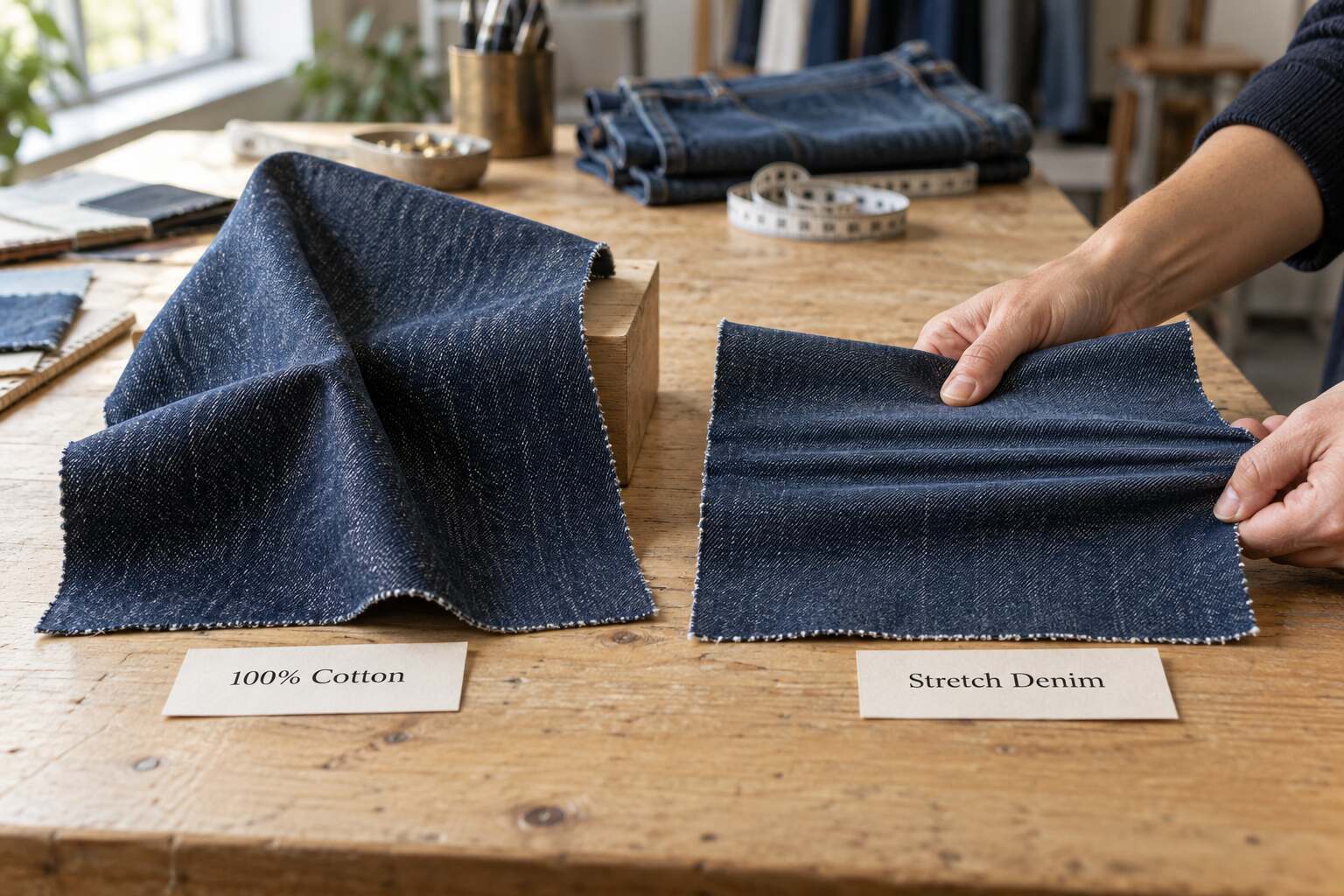
100% cotton jeans often provide a structured feel that softens and adapts with wear. Stretch denim incorporates construction or fibers that allow greater extension, often with elastic recovery. Neither option is automatically more comfortable or durable. Compare the actual fabric’s weight, flexibility, recovery, finishing, and garment fit against how your customer will wear the jeans.
Do 100% cotton jeans stretch with wear?
They can give and loosen during wear, particularly where the body places repeated pressure on the fabric. That does not mean every cotton jean behaves like an elastane blend. There is also an important exception to the assumption that all cotton fabrics must be rigid: engineered mechanical-stretch cotton constructions exist. Cotton Incorporated describes woven all-cotton technology that creates flexibility without synthetic stretch fibers. Consequently, “100% cotton” does not establish a single stretch behavior. Ask how much the fabric extends, in which direction, and how it behaves after recovery and washing.
How does stretch denim differ in flexibility and recovery?
Stretch measures extension; recovery describes the return toward the original dimensions afterward. A jean can feel easy to pull on but still develop baggy knees if its performance does not suit the fit. This distinction matters for online boutiques because the customer experiences the garment over a full day, while a fitting session may last only minutes. As a practical development step, assess sitting, walking, bending, and repeated wear, then inspect the waistband, seat, and knees. Agree on a test method and recovery period so competing fabrics are evaluated consistently.
Which fabrics offer the right balance of comfort, breathability, and structure?
Start with the wearing experience you want. A substantial denim may create the clean volume a baggy jean needs, yet feel too restrictive in a close-fitting thigh. A softer fabric can feel welcoming immediately, but may not hold architectural pockets or a sharply defined leg. Breathability also depends on construction, thickness, finishing, and how tightly the garment fits. Compare swatches and washed garments rather than making a comfort claim from cotton content alone. The table below offers development directions; it is not a ranking of fabric quality.
| Product priority | Direction worth sampling | What to verify |
| Defined, roomy silhouette | Structured rigid denim | Drape, weight, and movement ease |
| Close fit with mobility | Stretch denim | Extension, recovery, and waistband comfort |
| Soft, flowing silhouette | Softer cotton or cotton/lyocell options | Leg shape and growth during wear |
Natural-fiber composition | 100% cotton options | Actual flexibility and wash stability |
Comfortable repeat wear | Any suitable construction | Fit after movement and laundering |
Are 100% cotton jeans more durable than blended jeans?
There is no dependable rule that all-cotton jeans always outlast blends, or that added synthetic fibers automatically make jeans stronger. Durability needs to be evaluated in the finished product. A tight fit, weak seam, thin pocket edge, or aggressive distressed area may become the first point of failure regardless of the main fabric’s cotton percentage. For a brand, define what failure means for the intended product: tearing, abrasion, seam opening, or unacceptable loss of shape. Then select relevant fabric and garment tests. Paying for a heavier cloth will not solve every construction problem.
Do Cotton Denim Jeans Shrink, Fade, or Lose Their Shape?
Yes. Cotton denim can shrink during laundering, fade with washing and friction, and grow in stressed areas during wear. The amount depends on the fabric, processing, garment construction, and care conditions. Preshrinking and garment washing can reduce later dimensional changes, but the finished jeans still need testing. For brands, appearance and fit should be approved after the intended wash, not only before it.
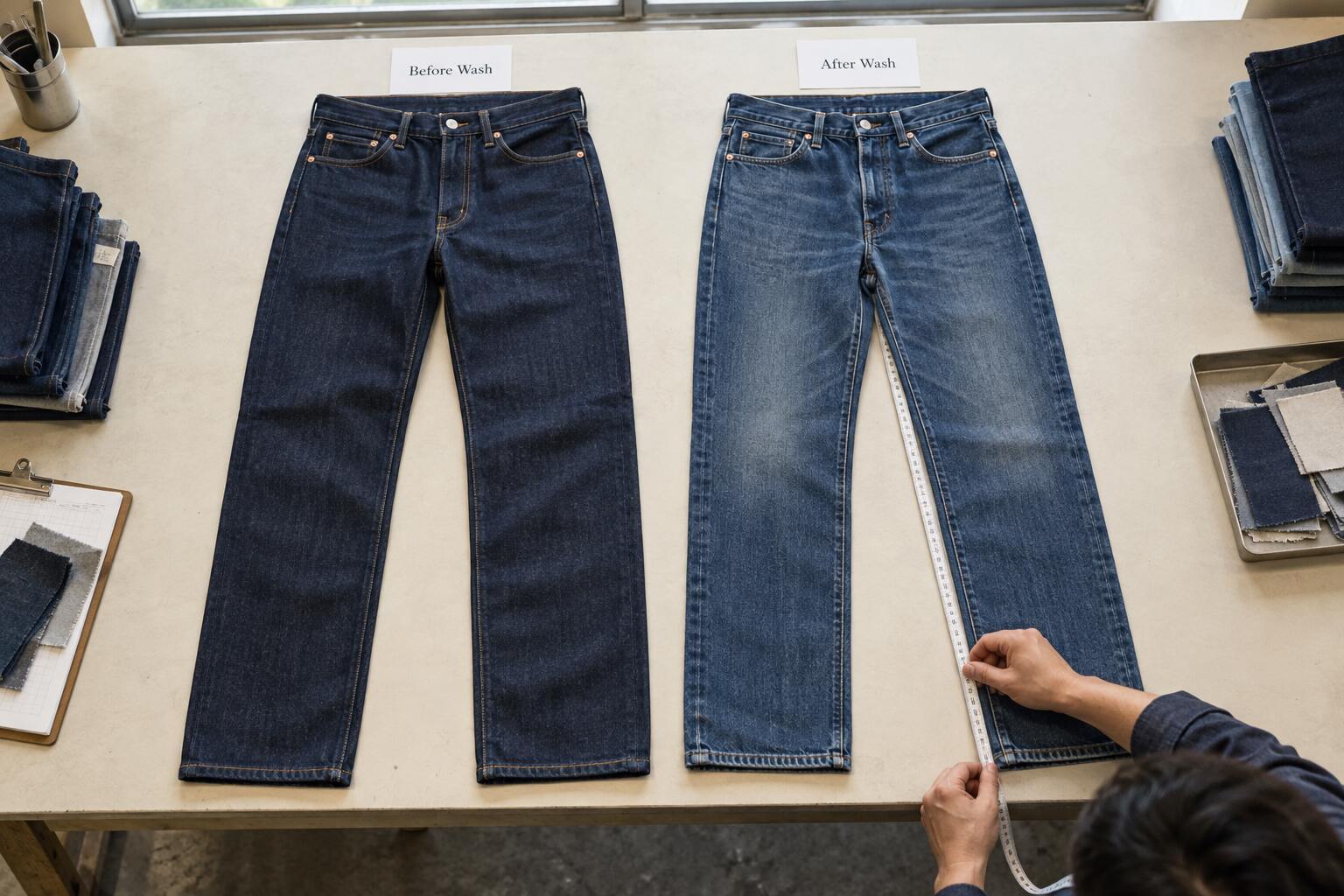
Why do jeans shrink after washing and drying?
Fabric carries stresses from manufacturing that can relax during processing and laundering. Construction and finishing therefore affect dimensional change alongside fiber content. CottonWorks emphasizes that shrinkage is influenced by variables across fabric production, sewing, finishing, and care. That is why a generic allowance cannot reliably cover every denim. Consider an illustrative test in which a 100 cm length finishes at 95 cm and a 50 cm width finishes at 49 cm. Those results are 5% lengthwise shrinkage and 2% widthwise shrinkage. They call for separate consideration in pattern development. CottonWorks™
How do raw, sanforized, and prewashed denim differ?
Raw denim generally has not undergone a garment wash. Sanforization is a fabric preshrinking process; prewashed jeans have already received a wash before sale. These descriptions can overlap: raw denim can be sanforized, and selvedge denim can be prewashed. Unsanforized products require particular attention to dimensional change. Levi’s, for example, distinguishes its unpreshrunk Shrink-to-Fit jeans from most of its preshrunk range. For a private-label project, request the fabric’s finishing status and tested shrinkage instead of applying a percentage copied from another product’s care guide. Naked & Famous Denim
How do fabric composition and washing affect denim fading?
The final appearance is influenced by dyeing, yarn characteristics, and finishing as well as composition. Two all-cotton denims may respond differently to the same wash recipe. CottonWorks describes denim finishing operations that alter softness, surface abrasion, and color appearance, illustrating why the wash is part of product development. If a faded reference image is central to your design, ask for a trial on the proposed fabric. Approve the resulting shade, contrast, and hand feel together. A convincing color match alone does not confirm that the finished garment has the required strength. CottonWorks™
Why do some jeans become loose at the waist or knees?
Repeated pressure can produce growth in areas that flex or stretch during wear. The result depends on fabric recovery and the amount of strain built into the pattern. A very close-fitting knee may reveal growth that is less visible in a relaxed leg made from the same cloth. Avoid treating extra stretch as a substitute for correct pattern development. Have fit testers wear the sample for realistic activities, record when measurements are taken, and compare the garment before wear, after wear, after recovery, and after laundering. Those observations help separate a fit issue from a fabric issue.
How should brands test shrinkage, stretch recovery, and wash appearance?
Build a small, documented approval plan around the final product. Identify the fabric lot, wash process, drying conditions, measurement points, and agreed tolerances. Test both lengthwise and widthwise dimensional change, then check the sewn garment because panels, seams, and trims interact. Compare shade and hand feel against the approved reference under consistent conditions, and assess leg twist separately from size. The example below illustrates how to organize decisions; its tolerances must be agreed for your product rather than treated as universal industry limits.
| Check | What to record | Development decision |
| Dimensional change | Before/after dimensions in both directions | Adjust pattern and confirm process |
| Stretch and recovery | Method, extension, recovery time, remaining growth | Confirm suitability for the fit |
| Washed appearance | Shade, contrast, surface, and hand feel | Approve or revise wash trial |
Finished fit | Waist, hip, thigh, inseam, and leg opening | Confirm measurements and wearing ease |
Leg twist | Seam rotation after laundering | Review fabric and garment construction |
How Can Fashion Brands Choose the Right Denim for Custom Jeans?
Choose denim by working backward from the customer, silhouette, and finished wash. Confirm composition, weight, structure, stretch, recovery, and shrinkage together. Then validate the fabric in a sewn, washed sample before approving bulk production. For complex custom jeans, discuss embroidery, distressing, hardware, and branding early so the fabric and construction support the complete design.
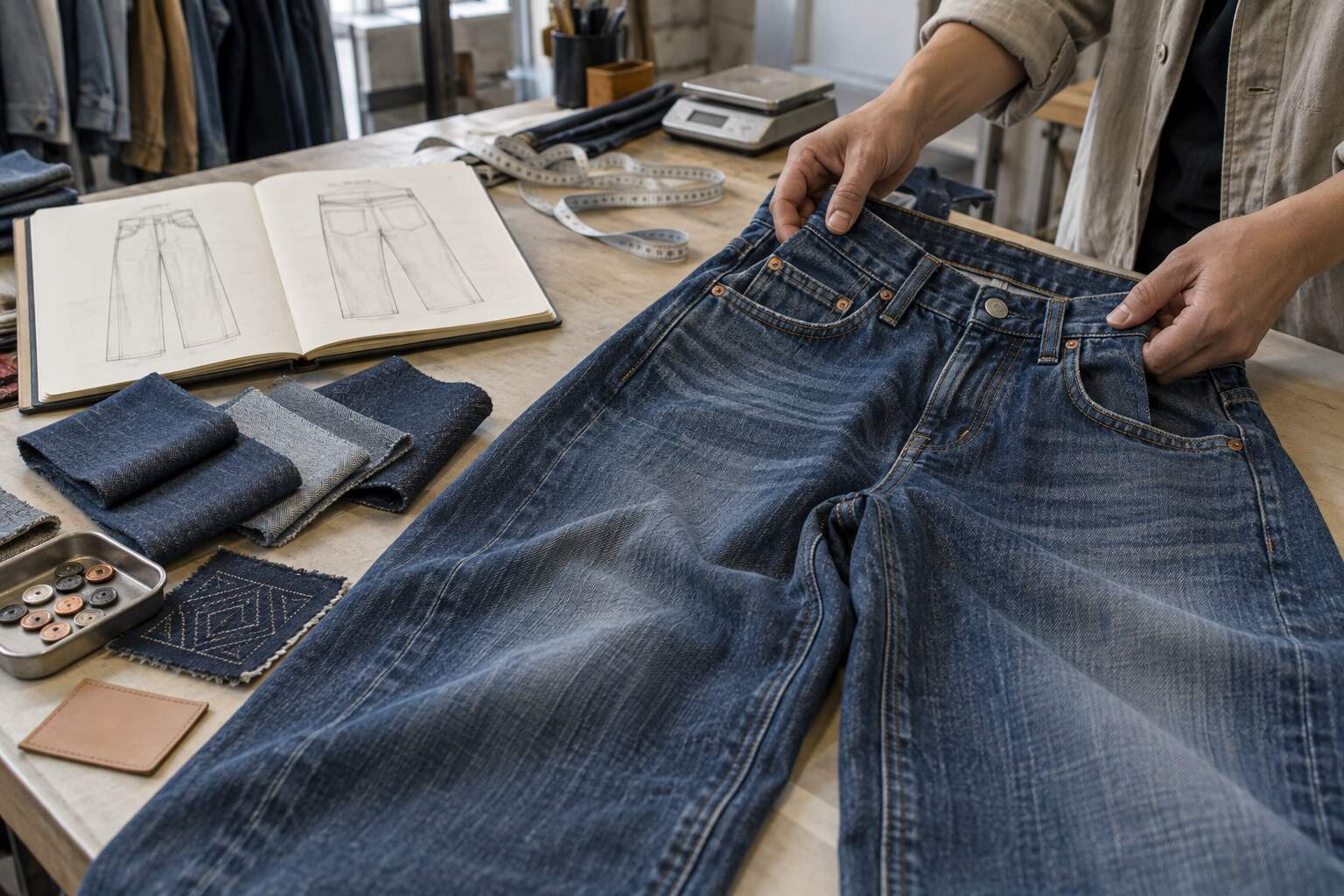
Which fabrics suit baggy, straight, stacked, skinny, and plus-size jeans?
A fit name gives a starting point, not a fabric prescription. Baggy and straight styles may need enough body to hold their intended volume. Stacked jeans need a considered relationship between leg shape, inseam, fabric flexibility, and footwear. Skinny jeans often benefit from stretch and recovery, while plus-size development requires appropriate grading and movement ease across the size range. Avoid assuming that every larger size needs stretch or every baggy fit needs heavy rigid cloth. Sample the actual proportions, then review how the fabric behaves on the intended wearer.
| Style | Main development question | What the sample should reveal |
| Baggy | Does the fabric hold the intended volume? | Balance between structure and drape |
| Straight | Does the leg remain clean after washing? | Leg line, twist, and finished dimensions |
| Stacked | Does the fabric gather as intended? | Stacking with the target inseam and footwear |
Skinny | Can the customer move comfortably? | Mobility, recovery, and seam strain |
Plus-size | Does the fit work across the size range? | Grading, waistband behavior, and movement ease |
Selvedge | Does the cloth suit both design and construction? | Edge placement, pattern layout, and finish |
How do embroidery, distressing, and heavy washes affect fabric selection?
Treat decoration and washing as part of the fabric brief. Dense embroidery needs a suitable relationship between fabric support, backing, stitch density, and placement. Distressing needs enough remaining strength for the intended use. Patches, rivets, and other hardware can also change how a panel hangs or feels against the body. For a complicated style, request a trial of the difficult area before approving the complete design. Review it after the intended processing sequence. A decoration that looks clean on an unwashed panel still needs evaluation in the final washed garment.
What fabric specifications should designers confirm with a jeans manufacturer?
Give your supplier more than a mood board. A practical brief identifies the target customer, fit, reference measurements, fabric composition, weight, stretch direction, recovery expectations, finished hand feel, and intended wash. Add decoration artwork, placement, trim requirements, and expected order quantities. State whether quoted weight refers to fabric before or after washing; denim weight is commonly expressed in ounces per square yard. If a requirement is still open, mark it as a development question. Clear uncertainty is easier to resolve than an assumption hidden inside a quotation.
How can brands validate fabric performance through sampling before bulk production?
Use each sample to answer a defined question. A development sample can establish proportions, pocket placement, and construction, but substitute fabric cannot confirm the behavior of the eventual bulk material. Before production approval, review a sample made with the intended fabric, trims, construction, and wash process. Keep the approved garment with its measurement record, fabric identification, wash reference, and tech-pack version. If any of those inputs change, assess whether a new trial is needed. This gives your team a concrete production reference when decisions move between design, sourcing, and quality control.
How can DiZNEW help turn a design concept into custom denim products?
DiZNEW is a China-based denim development and manufacturing factory with more than 20 years of experience. Its in-house sewing and washing capabilities support coordinated development of fabric, fit, and finish. Projects can include custom jeans, jackets, shorts, and shirts, with particular experience in complex denim styles and detailed customization. For independent designers and boutique owners, that means discussing how an idea will be made alongside how it should look. DiZNEW supports custom branding and OEM projects, with eligible orders starting at 30 pieces per style and wash, subject to fabric, trims, and size assortment, as well as larger orders of 10,000 pieces.
Ready to develop denim for your own brand? Send DiZNEW your sketch, tech pack, or reference images, together with your target fit, wash, size range, quantity, and delivery date. If you have a target unit price, include it so fabric and process options can be assessed against your budget. Request a custom quote through DiZNEW’s website and explain what you want your customer to see and feel when they put the jeans on. That is the right starting point for turning a fabric choice into a product worth buying again.
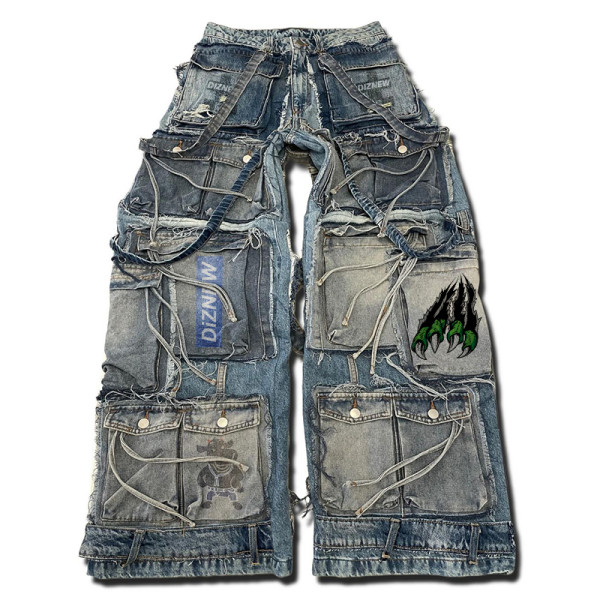
Washed denim cargo jeans with raw edge detail and oversized pockets for a bold streetwear look.
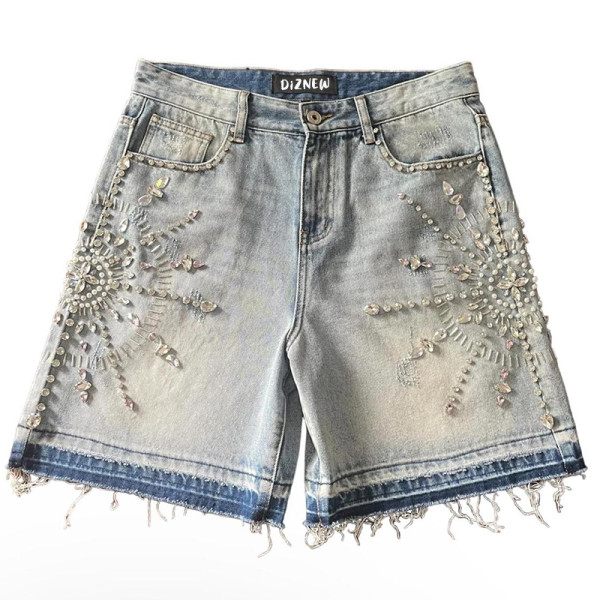
Custom Blue denim shorts with crystal detailing, blending luxury and street style. Stand out with this personalized denim design.
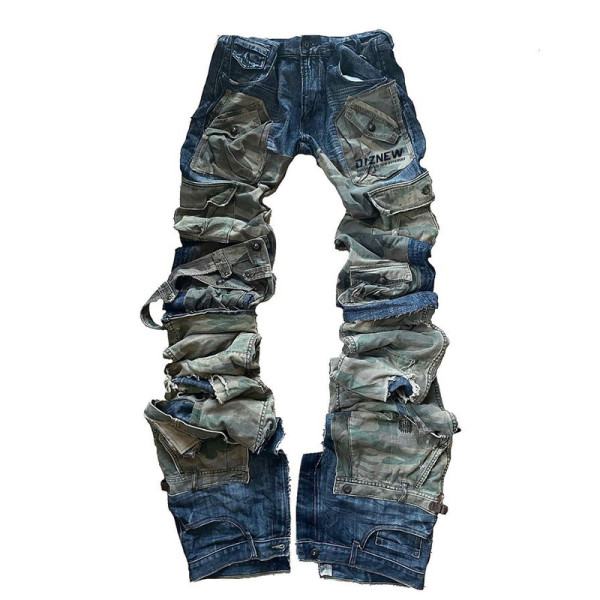
Custom deconstructed denim featuring military camo elements and stacked design. Premium cargo details for unique streetwear expression.
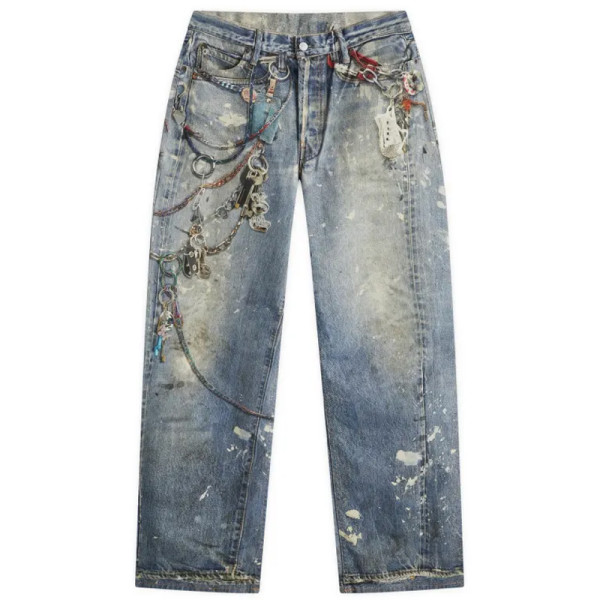
Loaded with chains and chaos—these jeans bring punk rebellion with dirty wash and full metal drip.